|
 |
Welcome
Meet
the New Chair of Physics
& Astronomy |
 Professor James Rosenzweig Professor James Rosenzweig
|
Professor James Rosenzweig was appointed
Chair of the Department of Physics& Astronomy as of July
1, 2010. After having served as Chair of the Department totaling
more than 14 years, Professor Ferdinand Coroniti steps down
to take a position
as Associate Dean in the College of
Letters and Science, Division of Physical Sciences.
Professor
Rosenzweig was born in Denver, CO, in 1960, and was raised
in Milwaukee, Wisconsin and in London, England. He received
his Ph.D., at the University of Wisconsin - Madison, 1988.
Upon graduation, he held an assistant physicist appointment
at Argonne National Labs, 1989 to 2000 was Robert R. Wilson
Fellow in Accelerator Physics at Fermilab. He joined the UCLA
Dept. of Physics faculty as an assistant professor in 1991.
Since 1999, he has been Professor of Physics at UCLA. He has
had visiting physicist positions at Argonne National Laboratory,
and Fermilab. On sabbatical in 2003 and 2007, he was Visiting
Professor, Universita di Roma "La Sapienza", and
visiting scientist at Laboratori Nazionale di Frascati (INFN-LNF).
He is a frequent lecturer in the US Particle Accelerator School.
Professor Rosenzweig is world renowned as an expert in the
physics of intense, ultra-fast charged particle beams and and
their interactions. These interaction scenarios include the
beam self-interaction, classified as single component relativistic
plasma physics, the beam-radiation interaction – e.g. the free-electron
laser – very high field acceleration in plasma or other media
driven by charged particle or laser beams. Prof. Rosenzweig
currently is the Director two laboratory programs, known collectively
as the Particle Beam Physics Laboratory, PBPL, in the physics
of advanced accelerators (the Neptune Lab on-campus at UCLA)
and the physics of free-electron-based radiation production
in world-leading off-campus labs. The PBPL maintains active
collaborations with other major accelerator facilities, such
as Fermilab, SLAC, BNL, LLNL, Argonne, DESY, Sincrotrone Trieste
and INFN-LNF (Frascati).
Prof. Rosenzweig is the author or co-author
of over 400 scientific articles, and several topical books
in beam and accelerator science. He has developed a course
on modern approaches to beam physics, Physics 150 "The Physics of Charged Particle
and Beam Physics", for which he has written a textbook,
published by Oxford University Press in 2003, entitled "Fundamentals
of Beam Physics".
Prof. Rosenzweig has received a Sloan Fellowship, a Robert
R. Wilson Fellowship, and an SSC Junior Faculty Fellowship.
He is a lifetime member and a Fellow of the American Physical
Society (APS). In 2007 he was awarded the 2007 International
Free-electron Laser Prize. Prof. Rosenzweig has served the
APS, as well as many high energy physics, light source, industrial
accelerator, and high energy density laboratory programs and
worldwide in organizational, advisory and leadership capacities.
|
|
| Message from Chair |
Welcome to the Department of
Physics and Astronomy Summer 2010 newsletter.
It is my extraordinary privilege, beginning July 1, 2010, to serve
as Chair of the Department of Physics and Astronomy. It is
indeed an honor to do so, as this Department possesses an extraordinarily
collegial and collaborative atmosphere. It is a place I have
felt professionally at home now nearly 20 years. The Department
is, despite great difficulties within the State and the University,
in excellent shape, due to the dedication and enthusiasm of the faculty,
staff, the student body, and – not in a small part – to the long
and distinguished service of the previous Chair, Ferd Coroniti. I
would like to wish Ferd well in his new position as Associate Dean
of Physical Sciences in the UCLA College of Letters and Science.
The present is a time of great change in the university, due to
changing budgetary support from the State, but it also is a time
of great opportunity. The research university finds itself
in a central position in the nation's economic recovery, and in its
economic future, as the federal government has placed unprecedented
emphasis on scientific research funding. As such, our Department
was uniquely placed to grow in its research reach in the past two
years. With our first-rate faculty, the response to this opportunity
was an overwhelming success. I note with pride that our Department
now has the largest external support of research funding in the UCLA
College of Letters and Science.
The story of the Department's progress goes well beyond numbers. It
is found in the remarkable diversity of subjects investigated by
the faculty, covering disciplines ranging from traditional areas
– e.g. the quest for the Higgs boson at the LHC – to emerging
new programs such as the physics of neuroscience. Our ambitious
research agenda is an integral part of the educational mission here
and energizes the faculty and students. I invite you to learn
more from this newsletter, and from the departmental website, which
provides continual updates on new developments here at UCLA.
The
Department of Physics & Astronomy Website
|
| Faculty Research Highlights |
JOHN
MIAO: Three-dimensional
structure determination from a single view
UCLA researchers, Kevin Raines, Sara Salha, Huaidong Jiang, Jose
Rodríguez and John Miao have played an important role in developing
this method. This work is also in collaboration with Richard Sandberg
and Henry Kapteyn of University of Colorado, Boulder and Jincheng
Du of University of North Texas.
| The ability to determine the structure of matter
in three dimensions has profoundly advanced our understanding
of nature. Traditionally, the most widely used schemes for 3D
structure determination of an object are implemented by acquiring
multiple measurements over various sample orientations, as in
the case of crystallography and tomography, or by scanning a
series of thin sections through the sample, as in confocal microscopy.
Now, the Miao group, in collaboration with Richard Sandberg and
Henry Kapteyn of University of Colorado, Boulder and Jincheng
Du of University of North Texas, has developed a novel 3D imaging
modality, termed ankylography (derived from the Greek words ankylos
meaning 'curved' and graphein meaning 'writing'), which under
certain circumstances enables complete 3D structure determination
from a single exposure using a monochromatic incident beam. With
further development, this approach of obtaining complete 3D structure
information from a single view could find broad applications
in the physical and life sciences. For more details, please refer
to the paper, which is published in Nature. Nature |
 |
GILL
TRAVISH: Creating
a Portable X-Ray Machine and Radius Health Joins Tech Incubator
at CNSI to Conduct Proof-of-concept Research
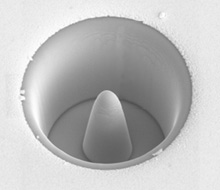
Gil Travish and collaborators have developed a Microemitter Array X-rays
(MAX) technology that has the potential to address the widespread
demand for both performance improvements and cost reductions in the
traditional vacuum tube-based technology of the X-ray-imaging market.
|
Electric point: This point, carved into a pyroelectric crystal,
emits electrons when the material is heated. A flat-panel x-ray
source uses an array of such points to make a more uniform field
for medical imaging.
Credit: Gil Travish |
Read more: Creating
a Portable X-Ray Machine and Radius
Health Joins Tech Incubator at CNSI to Conduct Proof-of-concept Research
ERIC
HUDSON: First
there were atomic clocks that beat at microwave frequencies. Then
along came optical clocks that provide higher frequency standards.
Now, physicists in the US have unveiled plans to build the first
"nuclear clock" that runs at still higher frequencies.Read article
in physicsworld.com
Plan
for 'nuclear clock' unveiled

|
Thorium doped crystal
under illumination by the Advanced Light Source beam at Berkeley
Lab in California. (Courtesy: Eric Hudson). |
EDWARD
L. (NED) WRIGHT: NASA's
WISE launched on Monday, December 14, 2009. An unmanned NASA satellite
that will survey the entire sky to discover millions of uncharted
stars and galaxies, asteroids, and planetary "construction
zones," providing valuable new information on our solar system,
the Milky Way and the universe. NASA'S Wide-field Infrared Survey
Explorer (WISE), launched from California's Vandenberg Air Force
Base on Dec.14, 2009, will map the sky at four infrared wavelengths
– invisible to the unaided human eye – with a sensitivity hundreds
of times greater than its predecessors. WISE will catalogue hundreds
of millions of objects.
 |
An infrared image of Edward L. (Ned) Wright, WISE's principal
investigator and a UCLA professor of physics and astronomy.
In the image, warm objects appear brighter than cool ones.
His eye sockets are the hottest and brightest, while his
clothes are cooler and look dark. NASA's Wide-field Infrared
Survey Explorer, or WISE, will measure infrared light from
asteroids, stars, galaxies and more.
Credit: NASA/JPL-Caltech
Read More: NASA'S WISE infrared satellite to reveal new galaxies,
stars, asteroids
|
- July 16 - WISE Eyes the Whole Sky – WISE will
complete its first survey of the entire sky on July 17,
2010. Visit WISE website
|

2010/WISE_telescope-developed by L3 Communications-SSG
Credit- NASA_JPL-Caltech_L-3 SSG-Tinsley |
ERIC
BECKLIN: an
emeritus astrophysicist at UCLA and SOFIA's project's chief science
adviser : NASA's Flying Telescope
Sees Early Success.
NASA has begun operating a flying telescope powerful enough to
record the birth of distant stars and planets. In late May it
made its first scientific flight, capturing images of Jupiter
and a nearby galaxy.
The telescope, which weighs 17 tons, is built into a 747 that serves as an airborne
observatory. It's called the Stratospheric Observatory for Infrared Astronomy,
or SOFIA, and it's a marvel of astronomy and aeronautics. NPR interview July
2, 2010

Robyn Beck/AFP via Getty Images |
NASA filled SOFIA's interior with workstations for airborne
scientists. |
February 2010 UCLA 'dark matter' conference highlights
new research on mysterious cosmic substance
UCLA
'dark matter' conference highlights new research on mysterious
cosmic substance.
UCLA
scientists discuss XENON100, the newest dark matter
detector
Dark matter, for more than 70 years is
as mysterious and unknowable a subject to science as the
legendary island of Atlantis has been to history. The ninth
Symposium on Sources and Detection of Dark Matter and Dark
Energy in the Universe was held at the Marriott Hotel in
Marina del Rey February 24 - 26, 2010. UCLA professor of
physics Katsushi Arisaka and Hanguo Wang, a UCLA physics
researcher, described the newest dark matter detector, XENON100,
which UCLA has been operating beneath Italy's Gran Sasso
mountain, some 70 miles west of Rome, in partnership principally
with Columbia University and Rice University, along with
seven other institutions in Switzerland, Portugal, Italy,
Germany, France, Japan and China.
|
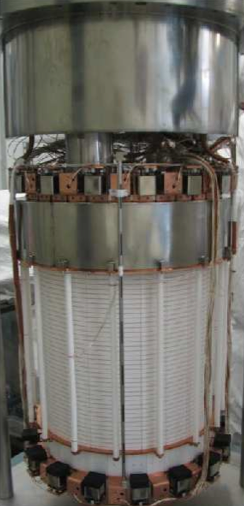 XENON100
Detector XENON100
Detector |
Back to top |
| Departmental Awards |
KATSUSHI
ARISAKA: Awarded
2010 UCLA Distinguished Teaching Award
The UCLA Physics & Astronomy Department
is very pleased to announce that Professor Katsushi Arisaka is
the recipient of a 2010 UCLA Distinguished Teaching Award. While
Dr. Arisaka is extremely successful at both undergraduate and
graduate instruction, he has been particularly effective in teaching
physics to non-physics majors. His special seminar for Physics
6B students, Physics 89, is especially praiseworthy. Often those
interested in biological science avoid mathematics and quantitative
reasoning. This is a particular challenge for students who wish
to attend medical school and who must take some physics. However,
by developing Physics 89, Professor Arisaka has very powerfully
and successfully introduced our students to science. This is
a central issue in modern education, and therefore Professor
Arisaka is most deserving of this Distinguished Teaching Award. See
UCLA Today Article |

Professor
Katsuchi
Arisaka |
STEVEN
FURLANETTO: Awarded 2010 Sloan Research Fellowship
The department is pleased to announce that Professor Steven
Furlanetto was just awarded a 2010 Sloan Research Fellowship.
The Sloan Research Fellowships seek to stimulate fundamental
research by early-career scientists and scholars of outstanding
promise. These two-year fellowships are awarded yearly to researchers
in recognition of distinguished performance and a unique potential
to make substantial contributions to their field.
You may also want to visit the Alfred P. Sloan Foundation website
to find out more about this prestigious organization. |

Steven
Furlanetto
|
|
| |
| Faculty
News |
Dean of the Division of Physical Scieces

|
Joseph
A. Rudnick was appointed Dean
of the Division of Physical Sciences in the College of Letters and Science effective August 1, 2009. Dean
Rudnick had been serving as acting dean of the Division of
Physical Sciences since October 2006. |
Andrea Ghez invited to TED (Ideas worth
spreading) in Oxford July 2009
 |
Andrea Ghez, a 2008 Macarthur Fellow, gave
an invited talk at Oxford at the TED Global Conference in July
2009. TED Global is a nonprofit gathering devoted to "ideas
worth spreading." Previous TED speakers have included
Bill Clinton, Bill Gates, Michelle Obama, Doris Kearns Goodwin,
and others. The hunt for a supermassive black hole has been
a subject of raging debate among astronomers for more than
a quarter of a century. Nothing can escape black holes, not
even light. In her talk Ghez addressed how astronomers observe
something they can't see. From
TED Website - listen to the talk Transcript of Andrea's
talk at TED |
|
| |
| Departmental
Events |
John
Cornwall 75th Birthday - November 14-15 th
 |
John Cornwall 75th Birthday - November
14-15th Quantum Field Theory and Beyond Celebrating John M.
Cornwall's 75th Birthday was held at UCLA, Department of Physics & Astronomy.
Attendees came from as far away as Kobe University in Japan,
China and Rio de Janiero, Brazil. Mike Cornwall has been a
faculty member at UCLA since 1965, where he does his research
in elementary particle theory. To learn more about Mike Cornwall's
75th birthday celebrationl visit
the website |
2009 - Celebrating 20 years of Infrared Instrumentation
and Science!

From
left: Eric Becklin, Ben Zuckerman, Dr.
Kandri Vural*, Dr. James Beletic*, Ferdinand
Coroniti, Michael Jura, Michael Fitzgerald,
James Larkin and Ian McLean |
Founded in 1989 by Erick Becklin and Ian
McLean, the UCLA Infrared Lab celebrated its 20th anniversary
in the Fall of 2009. The work of the lab is to produce instruments
for the Keck 10-meter telescopes and other upcoming facilities. A
celebration of this milestone was held in November 20, 2009. See
pictures of event
About the UCLA Infrared
Laboratory (pdf)
* Kandri Vural and James Beletic -senior executives of Teledyne
Imaging |
Robert Cousins presentation on the Large Hadron Collider, world's
largest science experiment March 31,2010 at UCLA
On
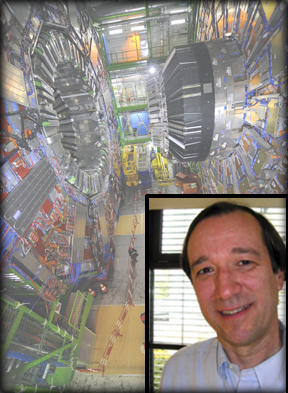
March 31, 2010, UCLA Professor Robert Cousins, who spent three years at CERN as a deputy to the leader
of one of the huge experiments at the Large Hadron Collider,
presented the goals of revolutionizing elementary particle
physics and the implications for our understanding of the Big
Bang and dark matter.
"I guess you couldn't get tickets to
Paul McCartney at the Hollywood Bowl," Cousins told the
more than 500 people who attended his talk. But it wasn't long
before his audience was thinking, "Maybe I'm Amazed." Watch
video
Find out more about the CMS (Compact
Muon Solenoid) at Cern.
Visit event site
Pictured right - background is CMS and foreground
is Professor Robert Cousins |
|
2010 Career Night
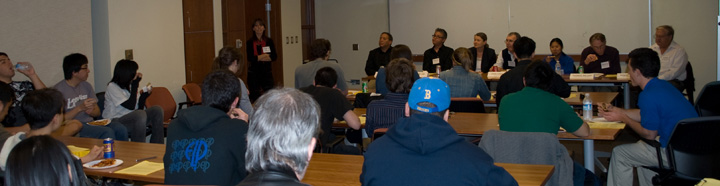
The department's annual Career Night on
April 12, 2010 was a great success with students and panelist
enjoying pizza, drinks and dessert, followed by interesting
questions from the students and equally interesting and helpful
answers from the panelists (Dan Dawes, Matthew Lee, John Taborn,
John Vaszari, Tatiana Vinogradova, Thomas Wilcox and Clara
Yoon). This
event provided the students with a wonderful opportunity to
talk with some of the department's alumni about the reality
of finding jobs after graduation in a variety of career paths. |
|
May 15, 2010 – UCLA Alumni Day
 May
15, 2010 UCLA Alumni Day |
The department once again was pleased
to have the opportunity to participate in UCLA Alumni Day. The astronomy students
offered 30 minute Planetarium shows throughout the day, and
during the morning a number of students volunteered to run
various physics demonstrations, as well as assist the alumni
and their families to view the sun via 2 solar telescopes. We
were pleased to see that these demonstrations generated a great
deal of interest and curiosity. There were always a number
of people at our tables enjoying the demos and asking questions. Additionally,
Professor Ian McLean, the director of the UCLA Infrared Laboratory
in Astrophysics, along with Anna Fisher, a NASA Astronaut,
spoke on the topic of "Watching the Skies: Bruins in
Space". They discussed dozens of ways that UCLA is helping
us understand the cosmos in manned and unmanned space exploration,
from discovering planets around distant suns, finding massive
black holes or visiting our nearest neighbors in the solar
system. |
WOMEN & ASTRONOMY
Astronomy is one of the most ancient of all the sciences
and has fascinated humankind since we first looked up at
the night sky. Nowadays people are becoming increasingly
aware of the study of celestial objects and phenomena as
astronomers discover more about the mysteries of the universe. Up
until early in the 20th century, noted astronomers were mostly
men, but women began to play a greater role in the field
from then on. On May 25, 2010, the UCLA Planetarium
hosted 50 guests, the maximum number for the planetarium,
in an event to showcase the cutting edge research of the
three women on our Astronomy faculty, Professors Andrea Ghez,
Alice Shapley, and Jean Turner. The event was a joint
effort by the Department of Physics & Astronomy and Women & Philanthropy. Those
attending were very enthusiastic about the event, and found
it a unique opportunity to learn about the "star" women in
astronomy. |
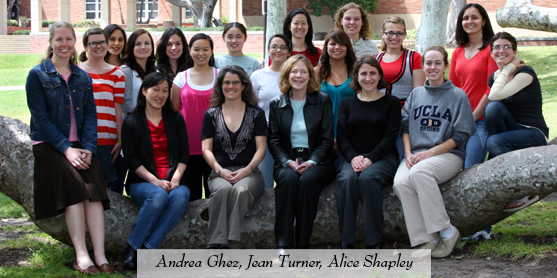
Astronomy faculty, surrounded by astronomy
undergraduate and graduate students, post-doctoral scholars
and researchers.
|
Commencement 2010
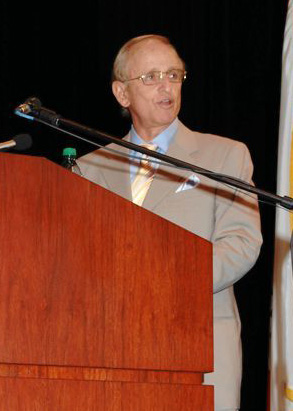 Ronald A Abelmann BS, MS (1960) Ronald A Abelmann BS, MS (1960)
Applied Physics,
UCLA
|
This year's commencement saw the largest
graduating class thus far in the department. In all, 75 undergraduate
degrees were conferred, 9 MS degrees and 26 PhD degrees. One
of the highlights was the address of alumnus Ron Abelmann,
our keynote speaker, who gave an inspiring and timely speech
about how to negotiate the professional world in these most
uncertain of times.
Read Ron Abelmann's speech |
2010 STAR
Analysis Meeting
The Department of Physics & Astronomy at UCLA hosted 80
plus people for the 2010 STAR Analysis Meeting. The meeting was held
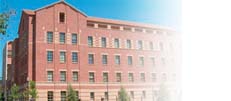
in the new Physics & Astronomy Building June 15-18, 2010. For
more information about the meeting visit
the meeting site.
|
| Campus
Outreach |
November 14, 2009 - Public Event to celebrate International Year
of Astronomy and
the launch of
Astronomy Live! website
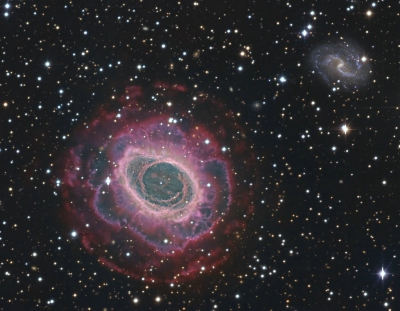 Nirvana-
astronomy picture of the day Nirvana-
astronomy picture of the day
|
The UCLA Physics and Astronomy and Earth
and Space Sciences Departments put on an exciting free public
event on Saturday Nov. 14th, 2009. The event was to celebrate
the International
Year of Astronomy and the launch of Astronomy
Live!. Astronomy Live! is UCLA's astronomy outreach
program run by a group of graduate students in the Department
of Physics and Astronomy.
In developing this program Astronomy Live!
wants to be able to visit schools, hospitals, and local
events to interact with the community in addition to fostering
interest in astronomy and science in general.
Visit Astronomy
Live! for more information
and upcoming events
PLANETARIUM: UCLA Planetarium
and Telecope Shows Public planetarium shows (suitable for all
ages) are given by current astronomy and astrophysics graduate
students. Content varies with presenters, but commonly includes
discussion about the current night sky, constellations, astronomical
phenomena, and more!
Wednesday Evening Public Shows:
Planetarium
Show - 8:00 PM
Telescope Viewing is subject to current
weather conditions.
Visit the planetarium website for more information
|
Research Experience for Undergraduates (REU program) 2010
The Physics & Astronomy
department is hosting the 8th annual Research Experience
for Undergraduates (REU program) during
Summer 2010. Fourteen undergraduate students have come came
from across the country to engage in real frontier level
research with a UCLA faculty member for a period of 10 weeks.
Each of the participants was matched with a faculty mentor
according to the student's stated interests.The projects spanned
the various fields represented in the department, such as plasma
physics, biophysics, cosmic ray physics, astrophysics, accelerator
physics. The students are being trained in the newest lab,
computational and theoretical techniques to prepare them
for the world of research. Over the last 8 years, the department
has hosted a total of 106 students under this program.

|
|
| |
| Giving |
Giving
to the Department of Physics & Astronomy:
The principal commitment of the UCLA Department of Physics and Astronomy
is to train the scientific leaders of the next generation and to expand
the limits of our knowledge of the nature of the universe in which
we live. Your generosity plays a vital role in our ability to fulfill
that commitment. Your gift to the UCLA Department of Physics and Astronomy
allows us to enrich and enhance our educational program and to create
new opportunities for students, faculty and all who benefit from the
pursuit of knowledge at the frontiers of human understanding.
Giving to P & A |
| Contacts: |
The
Department of Physics & Astronomy Website
Diana Thatcher
Assistant to the Chair
Email: thatcher@physics.ucla.edu |
James Rosenzweig, Chair
UCLA Department of Physics and Astronomy
Box 951547
Los Angeles, CA 90095-1547
(310)825-3440 (310)206-0864 Fax |
Please e-mail us if you do
not wish to receive this e-newsletter we will remove you from
our list. In subject line please type: remove from list
|
|